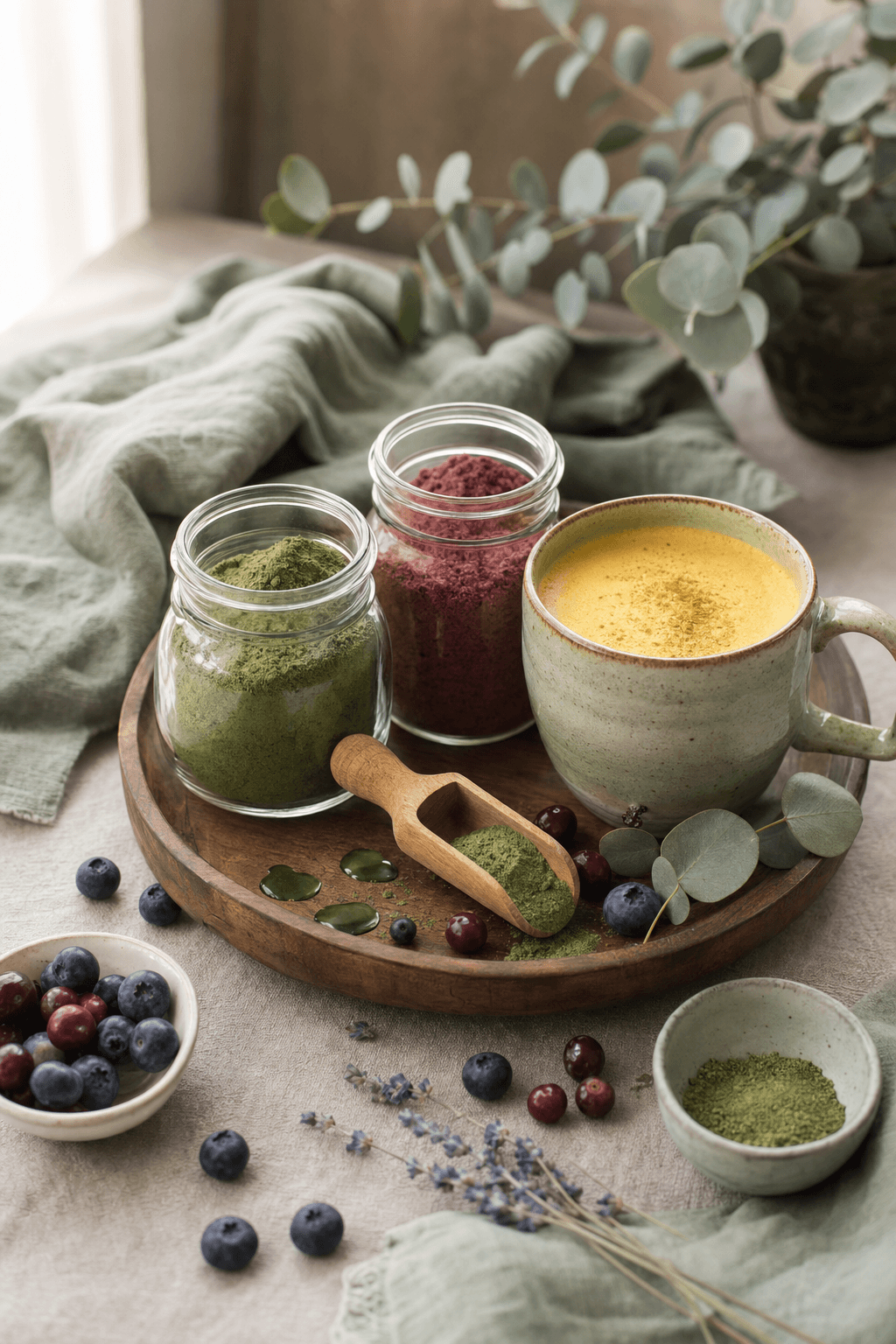

Choosing between superfood greens vs multivitamins depends on your health goals, as greens powders provide whole food phytonutrients and fiber while multivitamins offer concentrated, targeted doses of essential vitamins and minerals. While superfood greens are ideal for broad antioxidant support and digestive health, multivitamins are often more convenient for filling specific nutritional gaps.
Navigating the modern supplement aisle often feels like a full time job. You stand there wondering if that scoop of vibrant green powder truly replaces the precision of a high quality multivitamin. This dilemma is common for those seeking to optimize their health without cluttering their morning routine. Choosing the wrong form of supplementation can lead to wasted investment and gaps in your nutritional profile. In this guide, we examine the fundamental differences between the targeted accuracy of multivitamins and the broad, plant based diversity of superfood greens. You will discover the science of bioavailability, learn whether it is safe to combine both, and gain practical insights into modern alternatives like sea moss. By the end, you will have a clear framework for building a supplement protocol that aligns with your specific biological needs.
The Daily Dilemma: Greens Powder or a Multivitamin?
Standing in a local supplement aisle or browsing for natural wellness supplements online often leads to a functional standstill. The choice usually narrows down to two popular options: a green powder or a traditional pill. Understanding the distinction is vital for anyone in Randolph or the Greater Boston area trying to maintain a high performance lifestyle while balancing a busy schedule.
Greens powders are essentially dehydrated whole foods. These superfood blends consist of vegetables, grasses, and algae that have been dried and ground into a fine powder to preserve the integrity of the plant. In contrast, daily vitamins are concentrated, often synthetic, blends of isolated micronutrients designed to hit specific Recommended Dietary Intake (RDI) targets. They serve as a chemical blueprint for health rather than a food based source.
While convenience is the driving force for most professionals, knowing exactly what you are swallowing is the foundation of a routine you can actually stick to. This leads many to ask if greens powders are simply a waste of money. The truth is nuanced; it depends heavily on the quality of the formula and the specific gaps in your existing diet. Comparing superfood greens vs multivitamins is not about finding one winner, but about identifying which tool fits your specific physiological needs.
The Core Differences: Precision vs Diversity

The primary distinction between superfood greens vs multivitamins lies in their functional intent: one targets specific deficiencies with surgical accuracy, while the other provides a broad spectrum of plant based support. Daily vitamins are designed for precision. They deliver exact, measured doses of essential micronutrients like D3, B12, or Zinc. This approach ensures you meet the Recommended Daily Value (DV) for nutrients that might be missing from your diet due to local soil depletion or restrictive eating patterns. Think of a multivitamin as a targeted repair kit; it is the specific tool you reach for when you need to fix a known gap.
Conversely, superfood blends offer diversity through what scientists call the food matrix. This matrix is the complex structure of a whole plant, which includes fiber, digestive enzymes, and phytonutrients that isolated pills simply cannot replicate. While a multivitamin provides the isolated components of nutrition, greens provide the co-factors necessary for the body to recognize and process those nutrients effectively. In this scenario, the greens act as the whole construction crew. They do not just provide the raw materials; they provide the support staff and biological tools needed to integrate those materials into your body's systems.
Feature | Multivitamins (Precision) | Superfood Greens (Diversity) |
|---|---|---|
Primary Goal | Meeting specific RDI/DV targets | Broad-spectrum cellular support |
Nutrient Source | Isolated, often synthetic compounds | Dehydrated whole food concentrates |
Key Advantage | Accurate dosing for deficiencies | Includes phytonutrients and enzymes |
Gut Support | Minimal to none | High, often including fiber and probiotics |
Rather than focusing solely on a percentage on a label, greens prioritize antioxidants and plant based compounds that protect against oxidative stress. This makes them less about hitting a specific number and more about fostering a resilient internal environment. For those seeking natural wellness supplements that support real life, recognizing this balance between precision and diversity is the first step toward a functional daily routine.
Bioavailability: Natural vs Synthetic Vitamins
Understanding the difference between what you consume and what you actually absorb is the key to effective supplementation. Bioavailability refers to the proportion of a nutrient that enters the circulation and is able to have an active effect. While a label might boast a high percentage of a specific vitamin, those numbers are meaningless if the compound remains biologically unavailable to your cells.
Research cited by Healthline and various studies indexed on PubMed suggests that the body often processes natural and synthetic nutrients through different pathways. In superfood blends, vitamins are delivered within a complex web of enzymes, minerals, and phytonutrients. These co-factors act as biological keys, signaling to your cells that the nutrient is ready for use. This natural structure allows for smoother digestion and higher uptake, as the body recognizes the food-based source as fuel rather than a foreign chemical.
In contrast, many daily vitamins utilize isolated synthetic compounds that lack these natural partners. Without the food matrix, some high-dose synthetic pills may pass through your digestive system without being fully metabolized. To ensure your body actually utilizes your natural wellness supplements, you must look for active forms on the label. This is where many mass-market products fall short by using cheap alternatives that are difficult for the body to convert.
Nutrient | Synthetic Form to Avoid | Active Form to Seek |
|---|---|---|
Vitamin B12 | Cyanocobalamin | Methylcobalamin |
Folate (B9) | Folic Acid | 5-MTHF (L-Methylfolate) |
Vitamin B6 | Pyridoxine HCl | Pyridoxal-5-Phosphate (P5P) |
Magnesium | Magnesium Oxide | Magnesium Glycinate or Citrate |
Beyond the vitamins themselves, pay close attention to non-nutritional fillers. Many low-quality multivitamins contain titanium dioxide for color, hydrogenated oils as binders, or artificial dyes like Yellow 6. These additives can irritate the gut lining and hinder the absorption process. When evaluating superfood greens vs multivitamins, the presence of these synthetic shortcuts often dictates the true value of the product, as whole-food greens naturally bypass the need for these chemical stabilizers.
Do I Need a Multivitamin if I Take a Greens Powder?
Determining if you can simplify your shelf by swapping one for the other requires looking at your daily plate. While greens powders are incredible superfood blends, they are rarely a one to one replacement for a comprehensive multivitamin. Most greens formulas focus on alkalinity and phytonutrients, which means they often contain lower levels of minerals like Iron or Calcium and essential fat soluble nutrients like Vitamin D. If you rely solely on a powder, you might inadvertently miss the specific RDI targets that daily vitamins are designed to hit with surgical accuracy.
Redundancy is a valid concern for those with optimal diets. If your meals are already rich in diverse vegetables and you supplement with high quality natural wellness supplements, adding a multivitamin might be overkill. To decide how to balance superfood greens vs multivitamins, consider this checklist:
Situation | Recommendation |
|---|---|
Restricted Diet (Vegan, Keto, or Paleo) | Take both to cover micronutrient gaps and plant diversity. |
Frequent Meal Skipper or Busy Professional | Take both to ensure baseline nutrition during high stress. |
High Performance Athlete | Take both for recovery support and metabolic precision. |
Highly Varied, Whole Food Diet | A greens powder may be sufficient as a daily safety net. |
For most people balancing a high pressure lifestyle, using both offers a synergistic approach. The greens provide the digestive and antioxidant foundation, while the mu
Can You Take Super Greens and Multivitamins at the Same Time?

Taking both supplements is not only safe for most individuals but can create a synergistic effect that covers all nutritional bases. When navigating the choice of superfood greens vs multivitamins, you do not necessarily have to pick a side. However, caution is required regarding mega-dosing. Combining high-potency daily vitamins with nutrient-dense superfood blends can lead to an excessive intake of certain fat-soluble vitamins or minerals.
Check your labels for overlap in ingredients such as Vitamin A, specifically preformed retinol, and Selenium. While these are essential, excessive amounts can lead to toxicity over time. A balanced approach ensures you receive the plant-based phytonutrients from greens without pushing your micronutrient levels into a risky range. To maximize the efficacy of your natural wellness supplements, timing is essential.
Supplement | Recommended Timing | Purpose |
|---|---|---|
Multivitamin | With a fat-containing meal | Maximizes absorption of vitamins A, D, E, and K. |
Super Greens | Morning or 3 PM | Provides a hydrating, caffeine-free energy lift. |
For busy professionals, using greens in the mid-afternoon is a practical way to combat the 3 PM slump without relying on extra caffeine. This strategy allows the mu
The Rising Trend: Can You Replace Vitamins with Sea Moss?
Social media trends often lead customers to ask if they can bypass the superfood greens vs multivitamins debate by simply taking sea moss. This red algae has gained traction because it contains 92 of the 102 minerals found in the human body, including vital elements like iodine, potassium, and calcium. While sea moss is a powerhouse for mineral replenishment, it functions differently than other natural wellness supplements.
Comparing these three requires looking at their primary strengths. Superfood blends lean heavily on leafy greens and grasses to provide phytonutrients and antioxidants. Daily vitamins offer precise control over specific vitamin concentrations, such as Vitamin D3 or B12, which sea moss does not provide in high RDI percentages.
Supplement Type | Primary Strength | Key Missing Element |
|---|---|---|
Sea Moss | Broad Spectrum Minerals | Concentrated Vitamin RDI |
Greens Powder | Phytonutrients & Enzymes | High Mineral Density |
Multivitamin | Targeted Micronutrients | The Food Matrix & Fiber |
Rather than replacing your routine, sea moss acts as a mineral primer. It supports thyroid health and electrolyte balance, but it lacks the complex vitamin profiles and the concentrated chlorophyll found in greens. For those in Randolph seeking a comprehensive approach, sea moss is best viewed as a specialized mineral supplement rather than a catch-all solution.
Practical Tips for Your Daily Wellness Routine

Building a sustainable health habit does not require an overhaul of your entire life; it starts with small, manageable integrations that fit into your existing schedule. For those in Randolph balancing commutes and family commitments, the most effective routine is the one you actually remember to do. Practicality is the bridge between buying a supplement and feeling its benefits.
Step | Action | Nutritional Focus |
|---|---|---|
Morning Ritual | Mix superfood blends into Greek yogurt or a quick smoothie. | Fiber, alkalinity, and gut health. |
With Breakfast | Take daily vitamins with a meal containing healthy fats. | Optimal micronutrient absorption. |
3 PM Reset | Stir greens into cold water instead of reaching for more caffeine. | Natural energy and hydration. |
Mixing greens into yogurt is a favorite for a reason. It provides a creamy base that masks the earthy profile of the plants while adding a boost of protein. A common barrier
Finding the right balance between these two depends on your specific health goals and dietary needs. If you want expert help tailoring a supplement plan to your lifestyle, our team at AP Health is here to guide you. Discovering how our professional grade Products can support your daily routine is an excellent way to start. We are dedicated to helping you make informed decisions that promote sustainable, long term wellness.